
Exploring Mixtures and their Separation
1. Classification of Mixtures
Question: Which of the following mixtures are correctly classified as homogeneous (Hm) and heterogeneous (Ht)? Choose the correct option.
(i) Air-Hm, Milk-Ht, Sugar solution – Hm, Smoke – Hm
(ii) Brass-Ht, Fog – Ht, Vinegar – Ht, Muddy water-Hm
(iii) Copper sulfate solution – Hm, Salt solution – Hm, Milk – Hm, Bronze-Hm
(iv) Muddy water – Ht, Milk – Ht, Blood – Ht, Brass – Hm
Answer: (iv) Muddy water – Ht, Milk – Ht, Blood – Ht, Brass – Hm
Explanation: Muddy water, milk, and blood are heterogeneous mixtures (colloids or suspensions containing distinct phases), while brass is a homogeneous alloy. Option (i) is incorrect because smoke is heterogeneous (solid particles in gas); option (ii) is incorrect because brass, vinegar, and muddy water are misclassified; option (iii) is incorrect because brass/bronze are homogeneous, but milk is heterogeneous.
2. Tyndall Effect
Question: Which among the following mixtures show the Tyndall Effect? A mixture of: (a) air and dust particles, (b) copper sulfate and water, (c) starch and water, (d) acetone and water. Choose the correct option: (i) a and b, (ii) b and d, (iii) a and c, (iv) c and d.
Answer: (iii) a and c
Explanation: The Tyndall effect is exhibited by colloidal and suspension-sized particles that can scatter a beam of light.
(a) Air and dust particles (colloid/aerosol) and (c) starch and water (colloidal solution) both scatter light.
(b) Copper sulfate and water and (d) acetone and water are true solutions whose particles are too small (<1nm) to scatter light.
3. Properties of Solutions, Suspensions, and Colloids
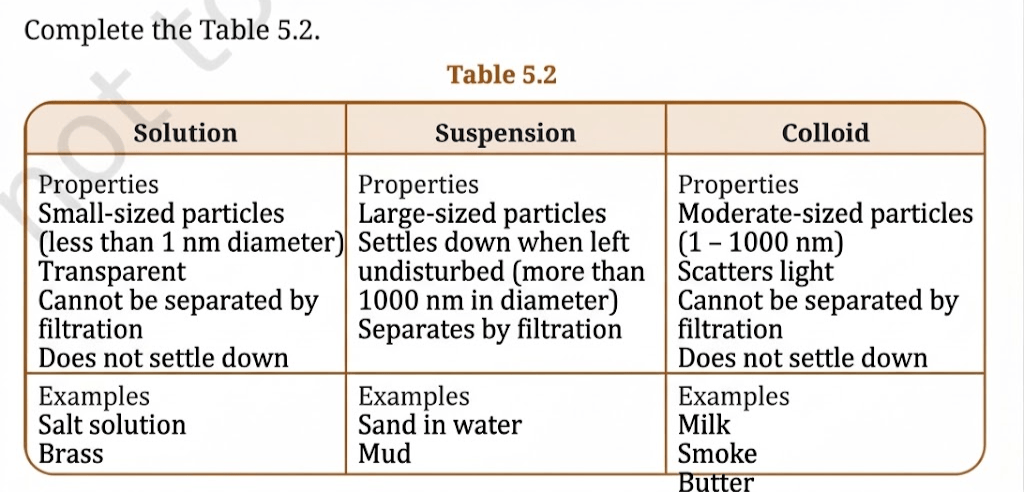
Question: Complete Table 5.2 using the words and phrases provided in the box.
Answer:
Solution:
Properties: Small-sized particles (less than 1 nm diameter); Particles remain evenly distributed; Transparent; Does not settle down; Cannot be separated by filtration.
Examples: Salt solution, Brass.
Suspension:
Properties: Large-sized particles (more than 1000 nm in diameter); Settles down when left undisturbed; Separates by filtration; Heterogeneous mixture.
Examples: Sand in water, Mud.
Colloid:
Properties: Moderate-sized particles (1–1000 nm); Scatters light; Does not settle down; Cannot be separated by filtration; Heterogeneous mixture.
Examples: Milk, Smoke, Butter.
—
4. Numerical Problems
Question (i): A cake recipe uses dry ingredients, namely 75 g of sugar for 420 g of all-purpose flour and 5 g of sodium hydrogencarbonate. Express the concentration of each component in the mixture using an appropriate method.
Answer:
Total mass of the mixture = Massofsugar+Massofflour+Massofsodiumhydrogencarbonate
Totalmass=75g+420g+5g=500g
Mass percentage (m/m):
Concentration of sugar = (75 / 500) × 100 = 15%
- Concentration of flour = (420 / 500) × 100 = 84%
- Concentration of sodium hydrogencarbonate = (5 / 500) × 100 = 1%
Question (ii): A brass alloy contains 70% copper by mass. Calculate the quantities of copper and zinc present in 120 g of brass.
Answer:
Totalmassofbrass=120g
Percentage of copper = 70% => Percentage of zinc = 100% – 70% = 30%
Massofcopper=70100120g=84g
Massofzinc=30100120g=36g
—
5. Cooking Oil and Water Mixture
Question: The label on a cooking oil pack says one litre (910 g). If this oil is mixed with water, will it form a separate layer? If so, which substance will be on top? How will you separate the two layers? Also, draw the diagram of the apparatus used.
Answer:
Layer formation: Yes, cooking oil and water are immiscible liquids and will form separate layers.
Top layer: Cooking oil will be on top because its density is less than that of water (910g/L=0.91g/cm3<1g/cm3).
Separation Method: A separating funnel is used.
Apparatus Description: Pour the mixture into a separating funnel and let it stand undisturbed for a few minutes so two distinct layers form. Open the stopcock of the funnel to drain out the lower water layer carefully, then close it as the oil reaches the stopcock.
—
6. Assertion-Reasoning on Tyndall Effect
Question:
Assertion (A): Solutions do not exhibit the Tyndall effect.
Reason (R): The particles in solutions are larger than 100 nm, so they cannot scatter light.
Choose the correct option.
Answer: (iii) A is true, but R is false.
Explanation: Solutions do not exhibit the Tyndall effect (Assertion is true), but this is because their particle size is extremely small (less than 1nm), not because they are larger than 100nm (Reason is false).
—
7. Table 5.3: Separation of Mixtures
Question: How would you separate the mixtures given in Table 5.3? Mention the reason for selection.
Answer:
Mud from muddy water:
Method: Filtration
Reason: Mud particles are insoluble and large enough to be retained by filter paper while water passes through.
Plasma from other components in the blood sample:
Method: Centrifugation
Reason: Blood cells are denser than plasma; spinning rapidly forces denser particles to the bottom.
Naphthalene and sand:
Method: Sublimation
Reason: Naphthalene sublimes directly from solid to gas upon heating, whereas sand does not.
Chalk powder and common salt:
Method: Dissolution in water followed by filtration and evaporation
Reason: Salt dissolves in water while chalk powder is insoluble (separated by filtration); the salt is then recovered from the filtrate via evaporation.
Salt and water:
Method: Evaporation or Distillation
Reason: Salt has a much higher boiling point than water, allowing water to vaporize and leave salt behind.
Oil from water:
Method: Using a Separating funnel
Reason: Oil and water are immiscible liquids of different densities.
Pigments of a flower/ink (Chromatography context):
Method: Paper chromatography
Reason: Components have different solubilities in a specific solvent and partition differently on filter paper.
—
8. Miscible Liquids Separation
Question: Two miscible liquids, A and B, are present in a mixture. The boiling point of A is 60C and the boiling point of B is 90C. Suggest a method to separate them. Also, draw a labelled diagram of the method suggested.
Answer:
Method: Simple Distillation (since the difference in their boiling points is 30C, which is greater than 25C).
Procedure/Diagram concept: Heat the mixture in a distillation flask. Liquid A (having the lower boiling point of 60C) vaporizes first, travels through the condenser where it cools and liquefies, and is collected in a receiver flask. Liquid B remains behind in the distillation flask.
9. Comparing Evaporation, Crystallization, and Distillation
Question: Compare evaporation, crystallization and distillation. In which situation, would you prefer each of these over the others?
Answer:
Evaporation: Vaporizes the liquid solvent completely to leave behind a solid solute. Used when a solid has dissolved in a liquid and we only need to recover the solid (and don’t care about saving the liquid, e.g., obtaining salt from sea water). However, impurities may remain.
Crystallization: Involves heating a solution to concentrate it, then allowing it to cool slowly to form pure solid crystals. Preferred over evaporation because evaporation can cause decomposition or charring of organic solids (like sugar), and crystallization produces purer solids by leaving soluble impurities in the mother liquor.
Distillation: Involves boiling a liquid to form vapor and then condensing the vapor back to liquid. Preferred when separating miscible liquids with different boiling points or when you want to recover both the solid solute and the liquid solvent (or two liquids) in pure form.
—
10. Blood as a Colloid
Question: Blood is an example of a colloidal mixture. (i) What would happen if blood behaved like a true suspension inside the body? (ii) In a blood sample, identify the dispersed phase and the dispersion medium.
Answer:
(i) If blood behaved like a true suspension, the blood cells (RBCs, WBCs, platelets) would be too large and heavy, causing them to settle down at the bottom of blood vessels due to gravity when circulation slows, preventing oxygen and nutrient transport and causing fatal clotting or blockages.
(ii)
Dispersed phase: Blood cells and platelets (cellular components).
Dispersion medium: Plasma (the liquid portion of blood).
—
11. Sequence of Separation Techniques for Sand, Common Salt, and Naphthalene
Question: Identify and write down the correct sequence of separation techniques for a mixture of sand, common salt, and naphthalene.
Answer:
1. Sublimation: Heat the mixture. Naphthalene sublimes (turns directly into vapor and can be condensed/recovered), leaving behind a mixture of sand and salt.
2. Dissolution and Filtration: Add water to the remaining sand-salt mixture and stir. Salt dissolves to form a solution, while sand remains insoluble. Filter the mixture to separate the sand .
3. Evaporation / Crystallization: Heat the filtrate (salt solution) to evaporate the water completely, leaving behind solid common salt .
—
12. Distillation of Water and Acetone
Question: Why is distillation an effective method for separating a mixture of water and acetone?
Answer:
Acetone (boiling point 56C) and water (boiling point 100C) are miscible liquids with a significant difference in their boiling points. When heated, acetone vaporizes at a much lower temperature than water, allowing it to be separated, condensed, and collected first, cleanly isolating it from the water.
—
13. Solubility Data Analysis
Question: Answer using Table 5.4 (Solubility of salts in 100g of water):
(i) What mass of potassium nitrate would be needed to prepare its saturated solution in 50 g of water at 40C?
Answer: From Table 5.4, the solubility of potassium nitrate at 40C is 62g per 100g of water.
For 50g of water, mass needed = 6210050=31g.
(ii) A student makes a saturated solution of potassium chloride in water at 80C and leaves the solution to cool at room temperature (25C). What would she observe as the solution cools? Explain.
Answer: She will observe crystals of potassium chloride separating out (precipitating) . Solubility decreases as temperature drops (from 54g at 80C down to about 35–36g at room temperature), meaning the water can hold less solute at lower temperatures, forcing the excess salt to crystallize.
(iii) What is the effect of a change in temperature on the solubility of salts? Also, compare the changes in the solubility of the four given salts with increasing temperature from 10C to 80C.
Answer: Generally, the solubility of most solid salts increases with an increase in temperature.
Comparison:
Potassium nitrate shows the most dramatic increase in solubility (from 21g to 167g).
Ammonium chloride and potassium chloride show moderate to significant increases.
Sodium chloride shows the least change in solubility with temperature, remaining nearly constant around 36–37g across the range.
—
14. Mass Percentage Calculations
Question: Three students, A, B and C, prepare sugar solutions:
A: 20 g sugar in 80 g water
B: 20 g sugar in 100 g water
C: 30 g sugar in 80 g water
(i) Calculate the mass percentage (m/m) concentration of sugar in each student’s solution.
(ii) Whose solution is the most concentrated? Explain why.
Answer:
(i) Calculations:
Masspercentage=MassofsoluteMassofsolution100
Student A: Solutionmass=20+80=100g. Concentration = (20 / 100) × 100 = 20%
Student B: Solutionmass=20+100=120g. Concentration = (20 / 120) × 100 = 16.67%
Student C: Solutionmass=30+80=110g. Concentration = (30 / 110) × 100 = 27.27%
(ii) Most Concentrated: Student C’s solution is the most concentrated because it contains the highest amount of solute (30g) dissolved in the smallest total mass-to-solute ratio, yielding the highest mass percentage (27.27%).
—
15. Fig. 5.26 Analysis (Fractional Distillation / Distillation)
Question: Examine Fig. 5.26:
(i) Identify the separation technique marked as ‘S’.
(ii) Label the apparatus A, B and C.
(iii) Which mixtures can be separated by this technique using Table 5.5?
Answer:
(i) Distillation (or Fractional Distillation if a fractionating column is present).
(ii) Labeling:
A: Distillation flask (containing the liquid mixture)
B: Water condenser
C: Receiver flask (Conical flask)
(iii) Suitable Mixtures from Table 5.5:
Mixtures whose components have a significant difference in boiling points can be separated. Looking at Table 5.5 (Water 100C, Acetone 56C, Alcohol 78C, Chloroform 61C, Benzene 80C), the suitable pairs are:
(a) Water – acetone (100C vs 56C — large difference)
(b) Water – salt (Salt is non-volatile, water vaporizes)
(Note: Closely boiling pairs like alcohol-benzene or acetone-alcohol require fractional distillation with a fractionating column).

