
The Building Block of Life
1. Differentiate between the following pairs of terms based on the clues given in parentheses:
(i) Cell membrane and cell wall (permeability):
- Cell membrane: It is selectively permeable (or semi-permeable), meaning it allows the movement of only certain molecules (like water and specific gases/nutrients) in and out of the cell.
- Cell wall: It is freely permeable, allowing almost all molecules of appropriate size to pass through it without selectivity.
(ii) RER and SER (structure):
- Rough Endoplasmic Reticulum (RER): Its outer surface has ribosomes attached to it, giving it a rough appearance under a microscope.
- Smooth Endoplasmic Reticulum (SER): It lacks ribosomes on its surface, making its membranes look smooth.
(iii) Chloroplasts and chromoplasts (pigments):
- Chloroplasts: Contain the green-colored pigment chlorophyll (along with carotenoids), which is essential for photosynthesis.
- Chromoplasts: Contain fat-soluble pigments other than chlorophyll, such as carotenoids (providing yellow, orange, or red colors) that give characteristic colors to flowers and fruits.
2. Two similar animal cells are placed in two different solutions…
Correct Option: (iii) Water moved into Cell X and moved out of Cell Y through the cell membrane.
Explanation: Pure water is a hypotonic solution, causing water to enter Cell X by osmosis (making it swell). A concentrated salt solution is hypertonic, causing water to move out of Cell Y by osmosis (making it shrink).
3. Identify the parts labelled from (a) to (g) in Fig. 2.20 and match them with their functions:
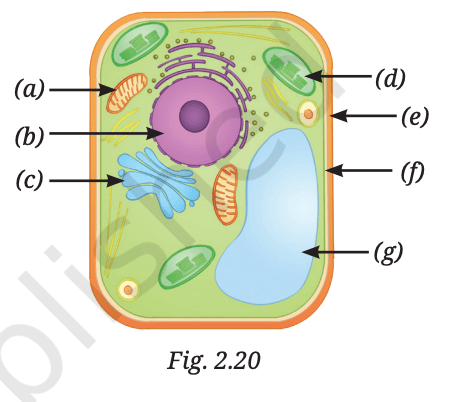
(a) Mitochondria (ii) Site of cellular respiration.
(b) Nucleus (i) Controlling all the activities of a cell.
(c) Golgi apparatus (vi) Packs and stores materials received from ER.
(d) Chloroplast (vii) Helps in manufacturing food.
(e) Cell wall (v) Provides structural rigidity to the cell.
(f) Cell membrane (iv) Separates the cell contents from surroundings.
(g) Vacuole (iii) Storage organelle that also provides rigidity to the cell.
4. Which of the following option(s) of the pairs of cell organelles are correctly placed…?
Correct Option: (i) Leucoplast (Present in plant cells) / Cell wall (Absent in animal cells).
5. Two students, Renu and Rohit, were having a discussion on the plastids… Who is correct?
Answer: Renu is correct.
Justification: Plastids are found in all plant cells, not just green photosynthetic tissues. While chloroplasts are absent in underground roots, roots contain other types of plastids like leucoplasts, which function mainly for the storage of nutrients such as starches, oils, and proteins.
6. Mitochondria and chloroplasts are two important organelles in a plant cell. Discuss how these two organelles are structurally and functionally similar… and different…
Similarities:
- Structural: Both are double-membrane-bound organelles and possess their own circular DNA and ribosomes, allowing them to synthesize some of their own proteins.
- Functional: Both are energy-transforming organelles—mitochondria produce chemical energy (ATP) via cellular respiration, while chloroplasts capture light energy to synthesize food (glucose) via photosynthesis.
Differences:
- Location/Occurrence: Mitochondria are found in almost all eukaryotic cells (both plant and animal), whereas chloroplasts are found only in plant cells and certain photosynthetic protists.
- Internal Structure: Mitochondria have inner membrane folds called cristae, while chloroplasts contain stacked disc-like structures called thylakoids (arranged in grana) embedded in a fluid called stroma.
7. Which of the following pairs of cell organelles contains DNA?
Correct Option: (ii) Mitochondria, Nucleus.
8. A researcher carried out an experiment in which she took two carrots…
(i) What hypothesis does she want to test through this experiment?
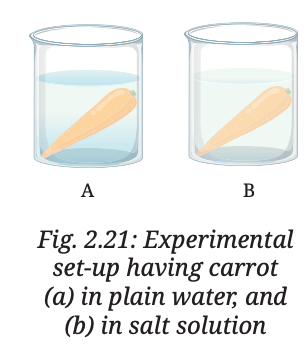
- She wants to test how external solutions of different concentrations (hypotonic plain water vs. hypertonic salt solution) affect plant tissues through osmosis.
(ii) What would you suggest for the improvement of this experiment?
- Use carrots of identical mass, length, and initial texture, measure their weight before and after the 24-hour period for quantitative data, and use a control group or duplicate setups for reliability.
(iii) Why does the carrot in plain water stay stiff and crunchy, but the carrot in concentrated salt solution become rubbery and limp?
- In plain water, water enters the carrot cells by endosmosis, creating turgor pressure that keeps the cells firm. In concentrated salt solution, water moves out of the carrot cells by exosmosis (plasmolysis), causing the cells to lose turgidity and become limp.
9. Indicate the presence or absence of following structures in bacterial and animal cells:
| Structures in a cell | Bacterial cell | Animal cell |
| Chromosome | Present (as a single circular DNA molecule in the nucleoid) | Present (multiple linear chromosomes within the nucleus) |
| Nucleus | Absent (incipient nucleus / nucleoid) | Present |
| Mitochondria | Absent | Present |
| Golgi complex | Absent | Present |
| Chromoplasts | Absent | Absent |
10. Carry out the following experiment… (Potato cups)

(i) Explain why water gathers in the hollowed portion of Cup B and Cup C.
- Water moves into the hollowed portion from the beaker via osmosis because the sugar/salt inside creates a hypertonic environment relative to the water outside, drawing water across the semi-permeable potato cell membranes.
(ii) Why is Cup A necessary for this experiment?
- Cup A (empty potato cup) acts as the control to prove that water movement/accumulation does not occur spontaneously without a solute gradient (sugar or salt) inside the cavity.
(iii) Explain why water does not gather in the hollowed portions of Cups A and D.
- Cup A has no concentration gradient to drive osmosis. Cup D uses a boiled potato; boiling destroys the selective permeability of the plasma membranes, killing the cells and halting active osmosis.
11. Identify the pair that incorrectly matches the cell organelle with its function:
Correct Answer: (ii) SER – Lipid and cellulose synthesis.
- (Reason: SER helps in lipid synthesis, but cellulose synthesis is carried out by plant cell machinery/enzymes, not the Smooth Endoplasmic Reticulum).
12. What outcome do you expect, if all the mitochondria are removed from a eukaryotic cell?
The cell will fail to generate ATP (cellular energy) via aerobic respiration. Deprived of energy, vital metabolic cellular processes will halt, leading rapidly to cell death (necrosis or apoptosis).
13. Which phenomenon inhibits the formation of tumors in the human body? Can plants also develop tumors? Explain.
In humans: Apoptosis (programmed cell death) and strict cell-cycle checkpoints inhibit tumor formation by destroying cells with damaged DNA before they can divide uncontrollably.
In plants: Yes, plants can develop tumors. For instance, crown galls are tumor-like growths in plants caused by infection with the bacterium Agrobacterium tumefaciens, which transfers foreign DNA into the plant’s genome, prompting uncontrolled cell division.
14. The cell membrane of a cell is made up of proteins and lipids. Which cell organelles help in the synthesis of cell membrane?
Synthesizing Organelles:
- Lipids are synthesized by the Smooth Endoplasmic Reticulum (SER).
- Proteins are synthesized by ribosomes attached to the Rough Endoplasmic Reticulum (RER).
Path of Compounds:
- Proteins and lipids are synthesized in the RER and SER.
- They are transported as vesicles to the Golgi apparatus for modification, sorting, and packaging.
- From the trans-face of the Golgi body, vesicles bud off and move to fuse with the cell membrane, integrating the new lipids and proteins to expand or repair it. (Draw a simple flow diagram showing: RER/SER Vesicles Golgi Apparatus Secretory Vesicles Cell Membrane).
15. What would happen if gametes are formed by mitotic divisions?
Mitosis preserves the diploid (2n) chromosome number. If gametes were formed by mitosis, they would remain diploid (2n) instead of being haploid (n). When fertilization occurs, the resulting zygote would double its chromosome number every generation (4n, 8n, etc.), causing genetic instability and collapse of the species’ normal development.
16. Case Study: Deepa (Amla and Lemon preservation)
(i) Which scientific concept has the farmer applied in the preservation of the farm produce?
- Osmosis and the creation of a hypertonic environment (using high concentrations of salt, sugar, or jaggery).
(ii) How does the addition of high concentrations of salt and sugar create an environment that prevents the growth of spoilage-causing bacteria and fungi?
- High salt or sugar concentrations create an external hypertonic environment. Water rushes out of the microbial cells via osmosis, causing them to undergo plasmolysis, dehydrate, and die or fail to reproduce.
(iii) Suggest a healthy recipe of this kind for food preservation.
- Amla-Honey Murabba (Amla pieces soaked and preserved in natural honey with a pinch of black salt and spices, which acts as a natural preservative without refined white sugar).
(iv) What are the scientific values addressed in this case?
- Resourcefulness, sustainable agricultural practices, waste reduction, application of biological principles (osmosis/microbial inhibition) to everyday entrepreneurship (agro-processing), and boosting rural food security and economy.

