
Exercise 1.1 Solutions
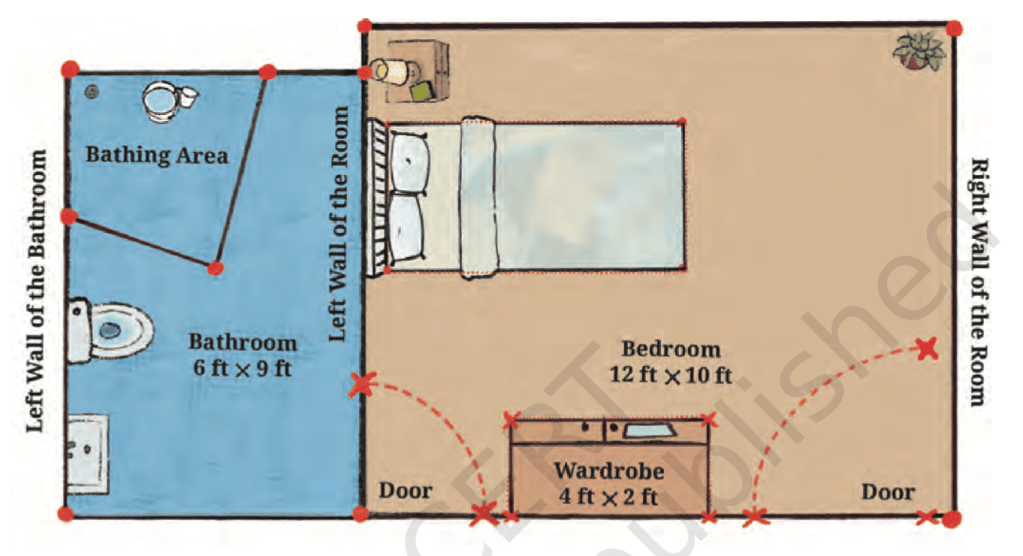
(i) Distance from the Walls
- Distance from the left wall (y-axis): The door starts at point D1, which aligns with the mark +8 on the x-axis. Therefore, the door is 8 units away from the left wall at its closest point.
- Distance from the floor line (x-axis): Since the door segment D1 R1 lies directly on the x-axis, its distance from the x-axis is 0 units.
(ii) Coordinates of D1
- Point D1 is located on the x-axis at the position marked 8. Any point on the x-axis has a y-coordinate of 0.
- Therefore, the coordinates of D1 are (8, 0).
(iii) Door Width and Accessibility
- Width Calculation:
Width = x-coordinate of R₁ – x-coordinate of D₁ = 11.5 – 8 = 3.5 units
Comfort & Accessibility Assessment:
Yes, assuming the units represent feet (standard for room blueprints), a width of 3.5 feet (42 inches) is very generous and exceptionally comfortable for an interior room door (standard doors are usually 2.5 to 3 feet wide). Since a standard wheelchair requires a minimum clear passage width of about 2.67 to 3 feet (32–36 inches), a person in a wheelchair will be able to enter the room very easily.
Exercise 1.2 Solutions
Question 1: Reiaan’s Study Table
- (i) Where will the fourth foot of the table be? The three given feet are at (8, 9), (11, 9), and (11, 7). The first two points form a horizontal line segment of length 3 units along y = 9. The second and third points form a vertical line segment dropping down by 2 units along x = 11. To complete the rectangle, the fourth foot must drop vertically down by 2 units from the first point (8, 9).
- Answer: The fourth foot will be at (8, 7).
- (ii) Is this a good spot for the table? Looking at the grid, the right edge of the bed sits at x = 7. Placing a table from x = 8 to x = 11 and y = 7 to y = 9 puts it right in front of the open space next to the bed. While it fits against the top wall, it leaves a very narrow walking clearance between the bed and the table.
- (iii) What is the width of the table? The length? Can you make out the height of the table?
- Length: 11 – 8 = 3 units (or 3 feet)
- Width: 9 – 7 = 2 units (or 2 feet)
- Height: No, you cannot determine the height because a 2D Cartesian coordinate plane only tracks flat, horizontal floor space (length and width), not the vertical height dimension.
Question 2: Bathroom Door Hinge Analysis
- Will it hit the wardrobe? The bathroom door spans from B1(0, 1.5) to B2(0, 4) on the y-axis, meaning its total length is 2.5 units. When it is hinged at B1(0, 1.5) and swings outward into the bedroom, its maximum reach flat against the bedroom floor will extend out to x = 2.5 at the height of y = 1.5. Looking at the wardrobe, its front-left corner is at W4(3, 2). Because the door’s reach (2.5) is less than the distance to the wardrobe (3), the door will not hit the wardrobe.
- Suggestions if the door is made wider: If the door is made wider than 3 units, its swing radius will strike the corner of the wardrobe at W4. To prevent this, you could:
- Move the wardrobe further to the right along the x-axis (e.g., start it at x = 4).
- Change the hinge point to B2(0, 4) instead, so the door swings upward toward the clear corner of the top wall.
Question 3: Look at Reiaan’s Bathroom
- (i) What are the coordinates of the four corners O, F, R, and P of the bathroom? By tracking the grid line limits to the left of the y-axis:
- O = (0, 0)
- F = (0, 10)
- R = (-6, 10)
- P = (-6, 0)
- (ii) What is the shape of the showering area SHWR? Write the coordinates of its four corners.
- Shape: The top wall (RW) and bottom wall (SH) are parallel horizontal lines, while the right wall line (HW) is slanted. A four-sided shape with exactly one pair of parallel sides is a Trapezium.
- Coordinates: By looking at the grid intersections:
- S = (-6, 6)
- H = (-3, 6)
- W = (-2, 10)
- R = (-6, 10)
- (iii) Mark off a 3 ft × 2 ft space for the washbasin and a 2 ft × 3 ft space for the toilet. Write the coordinates of the corners.(Note: Multiple valid layout options exist; here is a standard placement setup using the available walls)
- Washbasin (3 ft wide along bottom wall, 2 ft up): Placed in the bottom-left corner starting from point P(-6,0).
- Corners: (-6, 0), (-3, 0), (-3, 2), (-6, 2)
- Toilet (2 ft wide along left wall, 3 ft up): Placed right above the washbasin along the left wall.
- Corners: (-6, 2), (-4, 2), (-4, 5), (-6, 5)
- Washbasin (3 ft wide along bottom wall, 2 ft up): Placed in the bottom-left corner starting from point P(-6,0).
Question 4: Other Rooms in the House
- (i) Sketch the dining room and mark the coordinates of its corners. The dining room’s top wall shares the line segment stretching from P(-6, 0) to A(12, 0), matching a total horizontal length of 18 ft (12 minus -6 = 18). Because the dining room is located below Reiaan’s bedroom floor line, its 15 ft width must extend downwards into the negative y territory (from y = 0 down to y = -15).
- The four corners are:
- P = (-6, 0)
- A = (12, 0)
- Bottom-Right Corner = (12, -15)
- Bottom-Left Corner = (-6, -15)
- The four corners are:
- (ii) Place a rectangular 5 ft × 3 ft dining table precisely in the centre of the dining room. Write down the coordinates of the feet.
- Find the Center Point of the Room:
- Center X = (-6 + 12) / 2 = 3
- Center Y = (0 + (-15)) / 2 = -7.5
- Calculate Table Layout Limits:
- A 5 ft length means extending 2.5 units to the left and right of Center X:
- Left X = 3 – 2.5 = 0.5
- Right X = 3 + 2.5 = 5.5
- A 3 ft width means extending 1.5 units up and down from Center Y:
- Top Y = -7.5 + 1.5 = -6
- Bottom Y = -7.5 – 1.5 = -9
- A 5 ft length means extending 2.5 units to the left and right of Center X:
- Find the Center Point of the Room:
End of Chapter Exercise Solutions
Here are the solutions to the end-of-chapter exercise questions. All mathematical expressions are presented in plain text without complex code symbols.
Question 1
- Answer: The point of intersection of the two axes is the origin. Its x-coordinate is 0 and its y-coordinate is 0, written as (0, 0).
Question 2
- Answer: A line passing through W parallel to the y-axis is a vertical line where every point has the same x-coordinate. Therefore, point H will have an x-coordinate of -5, and its coordinates can be written as (-5, y).
- Since the x-coordinate is negative, H can lie in Quadrant II (if y is positive) or Quadrant III (if y is negative).
Question 3
Given points: R(3, 0), A(0, -2), M(-5, -2), P(-5, 2).
- (i) Two perpendicular sides: Side PM lies on a vertical line (from y = 2 to y = -2), and side AM lies on a horizontal line (from x = 0 to x = -5). Therefore, PM and AM are perpendicular to each other.
- (ii) One side parallel to an axis: Side AM connects (0, -2) and (-5, -2), sharing a constant y-value. Therefore, side AM is parallel to the x-axis. (Side PM is also parallel to the y-axis).
- (iii) Mirror images: Points M(-5, -2) and P(-5, 2) have the exact same x-coordinate, but their y-coordinates are equal in value and opposite in sign. Therefore, M and P are mirror images of each other across the x-axis.
Question 4
Let’s select a clean horizontal and vertical alignment using point Z(5, -6) to build a right-angled triangle IZN:
- Let point I be at (5, 0) (directly above Z on the x-axis).
- Let point N be at (0, -6) (directly to the left of Z on the y-axis).
- Side IZ length (vertical): 0 – (-6) = 6 units
- Side NZ length (horizontal): 5 – 0 = 5 units
- Side IN length (hypotenuse): Using the Pythagorean theorem: Square root of (6 squared + 5 squared) = Square root of (36 + 25) = Square root of 61 units (approximately 7.81).
Question 5
- Answer: Without negative numbers, the coordinate system would be limited entirely to Quadrant I (where both x and y are positive or zero). This system would not allow us to locate all points on an infinite 2D plane, as any space situated to the left of or below the designated origin point could not be mathematically calculated.
Question 6
- Method: To check if points M(-3, -4), A(0, 0), and G(6, 8) lie on the same straight line without plotting, calculate the slope between the points. The formula for slope is: (y2 – y1) / (x2 – x1).
- Calculation:
- Slope of MA = (0 – (-4)) / (0 – (-3)) = 4 / 3
- Slope of AG = (8 – 0) / (6 – 0) = 8 / 6 = 4 / 3
- Conclusion: Since Slope(MA) matches Slope(AG), the line segments share the exact same steepness and pass through a common point (A). This proves the points lie on the same straight line.
Question 7
Let’s use the slope method on points R(-5, -1), B(-2, -5), and C(4, -12):
- Slope of RB = (-5 – (-1)) / (-2 – (-5)) = -4 / 3
- Slope of BC = (-12 – (-5)) / (4 – (-2)) = -7 / 6
- Conclusion: Because the slopes do not match (-4/3 is not equal to -7/6), the points R, B, and C do not lie on the same straight line.
Question 8
(Note: There are multiple correct placements; below are standard configurations using the origin O(0,0))
- (i) A right-angled isosceles triangle: Set the right angle at the origin O(0, 0). Place vertex A on the x-axis at (4, 0) and vertex B on the y-axis at (0, 4). Both legs measure 4 units, making it right-angled and isosceles.
- (ii) An isosceles triangle with one vertex in QIII and the other in QIV: Set the top vertex at the origin O(0, 0). Place the second vertex in Quadrant III at (-3, -4) and the third vertex in Quadrant IV at (3, -4). The lengths of both side legs from the origin are equal (Square root of (3 squared + 4 squared) = 5 units).
Question 9
The midpoint calculation formula is: Midpoint = ((x1 + x2) / 2, (y1 + y2) / 2).
| S | M | T | Is M the midpoint? | Reason / Calculation |
| (-3, 0) | (0, 0) | (3, 0) | Yes | ((-3 + 3)/2, (0 + 0)/2) = (0, 0). |
| (2, 3) | (3, 4) | (4, 5) | Yes | ((2 + 4)/2, (3 + 5)/2) = (6/2, 8/2) = (3, 4). |
| (0, 0) | (0, 5) | (0, -10) | No | ((0 + 0)/2, (0 + -10)/2) = (0, -5). The given y-coordinate has the wrong sign. |
| (-8, 7) | (0, -2) | (6, -3) | No | ((-8 + 6)/2, (7 + -3)/2) = (-2/2, 4/2) = (-1, 2). This does not match (0, -2). |
Connection Formula: The coordinates of the midpoint are the simple averages of the endpoints: x_m = (x_s + x_t) / 2 and y_m = (y_s + y_t) / 2.
Question 10
To isolate the missing target coordinate, rewrite the connection formula: x_target = (2 * x_midpoint) – x_known and y_target = (2 * y_midpoint) – y_known.
Using Midpoint M(-7, 1) and Point A(3, -4) to find B(x, y):
- x = (2 * -7) – 3 = -14 – 3 = -17
- y = (2 * 1) – (-4) = 2 + 4 = 6
- Answer: The coordinates of B are (-17, 6).
Question 11
- Method: Trisection means breaking a line segment into three equal lengths. First find the total horizontal change (Delta x) and vertical change (Delta y), then divide them by 3 to find the size of a single step.
- Calculation for A(4, 7) and B(16, -2):
- Total horizontal shift = 16 – 4 = 12. Individual step size = 12 / 3 = 4.
- Total vertical shift = -2 – 7 = -9. Individual step size = -9 / 3 = -3.
- Point P (one step away from A):
- x = 4 + 4 = 8
- y = 7 + (-3) = 4
- P = (8, 4)
- Point Q (two steps away from A, or the midpoint of PB):
- x = 8 + 4 = 12
- y = 4 + (-3) = 1
- Q = (12, 1)
Question 12
- (i) Distance to origin O(0,0) calculation:
- Distance OA = Square root of (1 squared + (-8) squared) = Square root of (1 + 64) = Square root of 65
- Distance OB = Square root of ((-4) squared + 7 squared) = Square root of (16 + 49) = Square root of 65
- Distance OC = Square root of ((-7) squared + (-4) squared) = Square root of (49 + 16) = Square root of 65
- Since the distances from the origin to A, B, and C are perfectly equal, all three points sit on circle K. The radius of circle K is Square root of 65 units (approx 8.06).
- (ii) Position of D and E:
- Distance OD = Square root of ((-5) squared + 6 squared) = Square root of (25 + 36) = Square root of 61. Since Square root of 61 is less than Square root of 65, point D lies inside the circle.
- Distance OE = Square root of (0 squared + 9 squared) = Square root of 81 = 9. Since 9 (Square root of 81) is greater than Square root of 65, point E lies outside the circle.
Question 13
Given the midpoints D(5, 1) of AB, E(6, 5) of BC, and F(0, 3) of AC. You can use the midpoint geometry rule where: Vertex Coordinate = Sum of adjacent midpoints – Opposite midpoint.
- Vertex A (adjacent to D and F, opposite to E):
- x = 5 + 0 – 6 = -1
- y = 1 + 3 – 5 = -1
- A = (-1, -1)
- Vertex B (adjacent to D and E, opposite to F):
- x = 5 + 6 – 0 = 11
- y = 1 + 5 – 3 = 3
- B = (11, 3)
- Vertex C (adjacent to E and F, opposite to D):
- x = 6 + 0 – 5 = 1
- y = 5 + 3 – 1 = 7
- C = (1, 7)
Question 14
- (a) Intersections matching (4, 3): Exactly 1 unique crossing point exists where the 4th North-South street crosses the 3rd East-West street.
- (b) Intersections matching (3, 4): Exactly 1 unique crossing point exists where the 3rd North-South street crosses the 4th East-West street. These are two completely distinct locations.
Question 15
Screen boundary limits are x from 0 to 800, and y from 0 to 600.
- (i) Boundary check:
- Icon A: Center (100, 150), radius 80. Its left edge is at 100 – 80 = 20; right edge is at 100 + 80 = 180; bottom edge is at 150 – 80 = 70; top edge is at 150 + 80 = 230. All values sit safely inside the screen boundaries.
- Icon B: Center (250, 230), radius 100. Its left edge is at 250 – 100 = 150; right edge is at 250 + 100 = 350; bottom edge is at 230 – 100 = 130; top edge is at 230 + 100 = 330. All values sit safely inside the screen boundaries.
- Answer: No part of either circle icon lies outside the screen layout.
- (ii) Intersection check: Find the distance between centers A(100, 150) and B(250, 230):
- Distance = Square root of ((250 – 100) squared + (230 – 150) squared) = Square root of (150 squared + 80 squared) = Square root of (22500 + 6400) = Square root of 28900 = 170 pixels.
- The sum of the two radii is: 80 + 100 = 180 pixels.
- Answer: Since the distance between their centers (170) is less than the sum of their radii (180), the two circle icons intersect each other.
Question 16
Given vertices A(2, 1), B(-1, 2), C(-2, -1), and D(1, -2).
- Side lengths check:
- Side AB =(-1-2)2+(2-1)2 = 9+1 = 10
- Side BC =(-2-(-1))2+(-1-2)2 =9+1 = 10
- Side CD = (1-(-2))2+(-2-(-1))2= 9+1 = 10
- Side DA = (2-1)2+(1-(-2))2 = 9+1 = 10
- All side lengths are equal to Square root of 10, meaning it is a rhombus.
- Diagonals length check:
- Diagonal AC =(-2-2)2+(-1-1)2 =16+4 = 20
- Diagonal BD = (1-(-1)2+(-2-2)2 = 20
- Why it is a square: ABCD is a square because all four sides are equal in length (Square root of 10) and both diagonals are equal in length (Square root of 20), which guarantees 90-degree internal corner angles.
- Area calculation: Area = side squared = 10 * 10 = 10 square units.

